Client Portal
Raleigh, North Carolina

Investment Property Loans in Raleigh, NC

DSCR loans, plus fix and flip and ground-up construction financing, for investors buying or refinancing in Raleigh and surrounding cities.

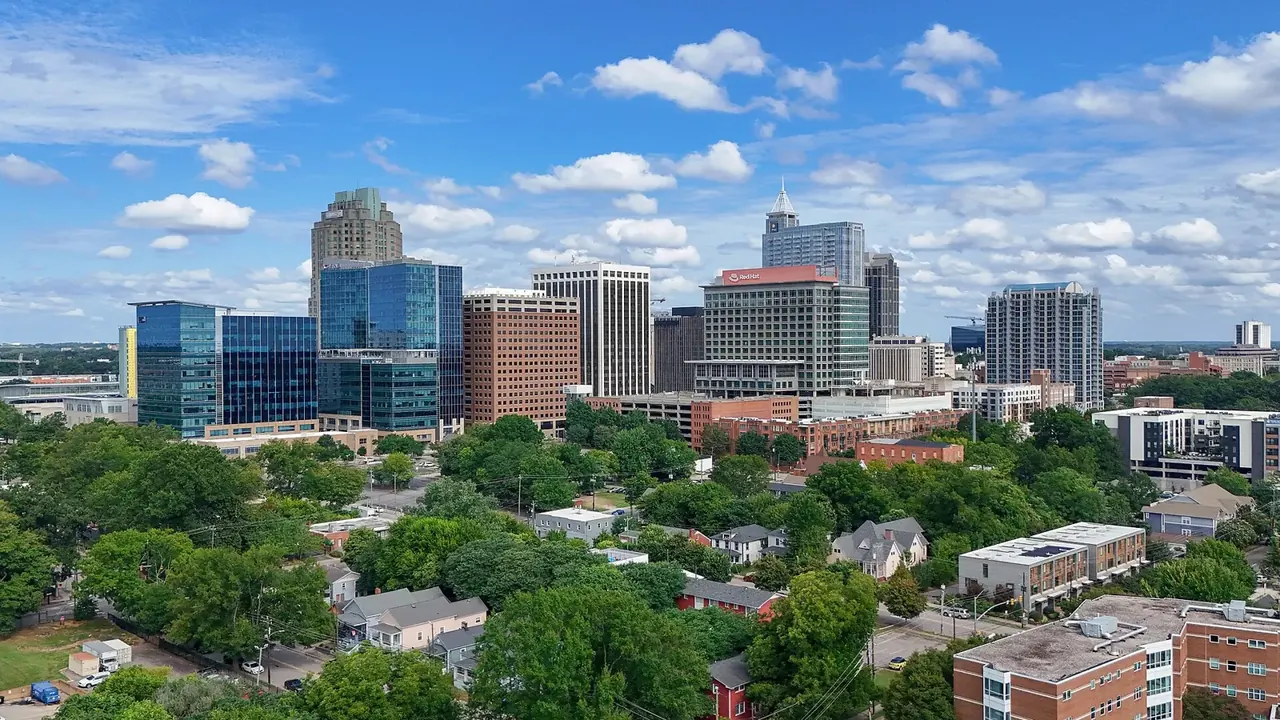
Raleigh skyline

Photo: Quintin Soloviev, CC BY 4.0, via Wikimedia Commons.

The Local Numbers

Raleigh Rental Market at a Glance

$428,671
Typical home value
-1.7% over 12 months
$1,577/mo
Typical rent
+0.5% over 12 months
4.4%
Annual rent to value
Typical rent x 12, divided by typical value

Source: Zillow Home Value Index (mid-tier single-family and condo) and Zillow Observed Rent Index for Raleigh, August 2026. Figures are market-wide typical values, not an appraisal or a quote.

Local Rules

Investing in Raleigh: The Local Rules

Short-term rentals

  • Every Raleigh short-term rental operator must first get a city zoning permit; the use is allowed, with conditions, in the R-1, R-2, R-4, R-6, R-10, RX, OX, NX, CX and DX districts.

    For investors: Look up the parcel on the city's iMaps zoning layer before an offer. The use table bars nightly stays in the OP and IX districts, and Raleigh requires a separate application, plus a signed Owner's Affidavit, for each short-term rental unit.

    Source: Raleigh UDO Sec. 6.4.6.E (Short-Term Rental) and Sec. 6.1.4 use table; City of Raleigh Short-Term Rental Application and Checklist (rev. 03.07.23), Oct 2026

  • In any single Raleigh building with multi-unit living, short-term rentals may occupy no more than 25% of the dwelling units or two units, whichever number is greater.

    For investors: On a Raleigh fourplex the two-unit floor is what binds, since 25% of four is one, so two doors can take nightly guests. The application asks multi-unit owners for a labeled layout of every floor and unit, so decide which units go short term before filing.

    Source: Raleigh UDO Sec. 6.4.6.E; Short-Term Rental Application and Checklist (rev. 03.07.23), Oct 2026

  • Raleigh operators must post the zoning permit number on the property and in every advertisement and keep a list of lodgers for three years; in residential districts, guests may not hold special events or gatherings.

    For investors: Build the permit number into every listing template from the start, and skip yard signs, since exterior advertising is banned. The same section bars bedroom cooking setups such as a 220 volt range or a refrigerator over seven cubic feet unless the unit is a one-room studio.

    Source: Raleigh UDO Sec. 6.4.6.E (Short-Term Rental use standards), Oct 2026

  • Raleigh must revoke a short-term rental permit after two or more verified zoning, noise or nuisance violations on the premises within 365 days, and no new permit can issue there for 365 days.

    For investors: A revoked permit shuts off stays of 30 days or less at that Raleigh address for a year, so party rules, quiet hours and a local contact belong in the business plan. When buying a running rental, ask the seller for any violation notices from the past year.

    Source: Raleigh UDO Sec. 6.4.6.G (Revocation of permit), Oct 2026

  • Wake County has levied a 6% room occupancy tax since 1991, and it reaches homes rented through sites such as Airbnb or VRBO; stays of 90 or more consecutive days are exempt.

    For investors: Raleigh's permit conditions require paying occupancy taxes, and Wake asks each operator to file a Gross Receipts Tax Application for an account number. Returns are due by the 20th, and a month with no bookings still needs a zero-due return.

    Source: Wake County Tax Administration, Room Occupancy Tax, Oct 2026

Property tax

  • For tax year 2026, Wake County's rate is 53.71 cents and the City of Raleigh's is 37.2 cents per $100 of value, up from 51.71 and 35.5 cents in 2025.

    For investors: Wake includes the city levy on its own bill, along with a $20 residential waste reduction fee charged per living unit, so a Raleigh duplex pays that fee twice. Parcels in the Raleigh or Hillsborough Street municipal districts add a district rate shown on the same chart.

    Source: Wake County Tax Administration, Tax Rates Current to 2017 chart (June 2026) and Tax Rates & Fees page, Jun 2026

  • Raleigh's tax values come from Wake County's January 1, 2024 revaluation. The next takes effect January 1, 2027; owners start receiving notices by January 22, 2027, and appeals are planned to close April 30, 2027.

    For investors: A Raleigh rental bought since 2024 may carry a tax value that differs from its price, so budget taxes from the 2027 notice rather than the seller's old bill. Appeals go to the Board of Equalization and Review, and Wake plans revaluations every two years after 2027.

    Source: Wake County Tax Administration, Revaluation 2027, Oct 2026

ADUs and lot splits

  • Raleigh allows one accessory dwelling unit per lot in R-1 through R-10, or two inside a Frequent Transit Area, capped at 800 square feet on lots of 40,000 square feet or less.

    For investors: An ADU cannot be sold apart from the main house, so its value shows up as rent, long term or under its own short-term permit. Flag lots are excluded and a detached unit needs six feet of separation from other buildings, so check lot shape before pricing a backyard cottage.

    Source: Raleigh UDO Sec. 2.6.3 (Accessory Dwelling), TC-1-25, Oct 2026

  • Raleigh's use table permits two-unit living in R-2 through R-10 and multi-unit living in R-6 and R-10; in R-2 and R-4, multi-unit is allowed only in compact, conservation or frequent transit developments.

    For investors: Every Raleigh residential district except R-1 lists a duplex as a permitted use, while a fourplex on an R-2 or R-4 lot needs a compact, conservation or frequent transit development. In R-1, a second unit is permitted only with the tiny house building type.

    Source: Raleigh UDO Sec. 6.1.4 use table and Sec. 6.2.1 (Household Living), Oct 2026

Flood zones

  • FEMA's October 1, 2026 Community Rating System list rates the City of Raleigh Class 5, a 25% flood insurance premium discount, while unincorporated Wake County sits at Class 10 with no discount.

    For investors: Standard property policies exclude flood, so a Raleigh rental in a mapped floodplain needs its own flood policy to be covered, and the city's class lowers that premium. Check the address in the city's Flood Information Portal and confirm it sits inside city limits, not unincorporated Wake.

    Source: FEMA, CRS Eligible Communities, October 1, 2026, Oct 2026

Utilities

  • Raleigh charges single-family homes a monthly stormwater fee by impervious area: $3.39 for 400 to 1,000 square feet, $8.47 to 3,870, $14.40 to 6,620 and $24.56 to 9,500.

    For investors: The fee appears on the monthly city utility bill. Small apartment buildings pay a formula rate of $8.47 per 2,260 square feet of hard surface instead, and adding a driveway, patio or backyard ADU can push a house into a higher tier.

    Source: City of Raleigh Stormwater, Stormwater Utility Fee (rates as of July 2026), Oct 2026

What drives rental demand

  • Wake County Economic Development lists the State of North Carolina at 24,083 jobs, WakeMed at 10,307, NC State University at 9,019 and the City of Raleigh at 3,974 among the area's largest employers.

    For investors: Raleigh is the state capital and home to NC State and WakeMed's hospitals, so units with an easy commute to downtown, the campus or a WakeMed campus can draw from those workforces. Leases timed to the academic year suit units near the university.

    Source: Wake County Economic Development, Major Employers (Wake County and RTP, 2,000+ employees), Oct 2026

Five-Year Trend

Raleigh Home Values and Rents, Month by Month

Zillow typical values, Aug 2021 to Aug 2026. Tap a chart to read any month.

Typical home value $428,671 Aug 2026 +17.5% over 5 years
$354k $408k $461k 202120222023202420252026
Typical rent $1,577/mo Aug 2026 +12.3% over 5 years
$1,382 $1,494 $1,606 202120222023202420252026
DSCR Explorer

Would a typical Raleigh rental cover its own payment?

Rent divided by the full monthly cost. Move the sliders.

1.00
estimated DSCR
Loan amount
Principal and interest
Taxes, insurance, dues
Total monthly cost
Estimated DSCR by loan-to-value
1.00
60%
1.00
65%
1.00
70%
1.00
75%
1.00
80%

Illustration only: 30-year amortizing payment, Zillow typical values (Aug 2026). Not an appraisal or a quote.

Beyond Single-Family

Small Multifamily Rentals in Raleigh

Rental Housing by Building Size

Of 96,029 renter-occupied homes in Raleigh:

  • 2 to 4 units10,483 (10.9%)
  • 5 to 9 units13,012 (13.6%)
  • 10 to 19 units18,313 (19.1%)

Median gross rent $1,468/mo · renters are 49% of households.

Source: U.S. Census Bureau, American Community Survey 5-year estimates (2019 to 2023), tables B25032, B25064 and B25003 for Raleigh.

Investor Questions

Raleigh Investor FAQ

Which Raleigh zoning districts allow nightly rentals of a whole house?

R-1, R-2, R-4, R-6, R-10, RX, OX, NX, CX and DX, where it is a limited use. You need a city zoning permit first, the permit number must appear on the property and every listing, and two or more verified zoning, noise or nuisance violations in 365 days lead to revocation.

Source: udo.raleighnc.gov

How many units in a Raleigh apartment building can be short-term rentals?

No more than 25% of the dwelling units in any single building, or two units if that number is greater. The application asks for a labeled layout of every floor and unit in the building, plus a separate application for each short-term rental unit.

Source: cityofraleigh0drupal.blob.core.usgovcloudapi.net

What property tax does a Raleigh rental pay?

For tax year 2026, Wake County charges 53.71 cents and the City of Raleigh 37.2 cents per $100 of value, both on one county bill. Values reset with Wake's revaluation effective January 1, 2027.

Source: s3.us-west-1.amazonaws.com

Can I add an accessory dwelling unit to a Raleigh rental lot?

In R-1 through R-10, one ADU is allowed per lot, or two in a Frequent Transit Area, capped at 800 square feet on lots of 40,000 square feet or less and smaller than the main home. It cannot be sold separately and is not allowed on flag lots.

Source: udo.raleighnc.gov

North Carolina

North Carolina Rules Investors Ask About

Prepayment penalties

North Carolina bans prepayment penalties only on first-lien home loans of $150,000 or less made to individuals for personal use on their principal dwelling; otherwise lender and borrower may agree prepayment terms.

Source: N.C. General Statutes §24-1.1A(b), Oct 2026

Transfer tax

North Carolina charges an excise tax of $1 per $500 of price (0.2%) on deeds, and the statute makes the seller (transferor) responsible for paying it before the deed is recorded.

Source: N.C. General Statutes §105-228.30, Oct 2026

All North Carolina city guides ›

LiButti Capital

Get your personalized rate.

Tell us about the deal. No tax returns, and no credit pull to see where you stand.

📞 Call us now (650) 200-2304
8% complete · Loan type
⏱ About 30 seconds ✓ No credit pull to see your rate ✓ No tax returns — the property qualifies, not your paycheck

What kind of loan are you looking for?

Are you the investor, or a broker?

What are you looking to do?

Where are you in the purchase?

What type of property is it?

How will it be rented?

What's the monthly market rent?

Current or expected rent — a ballpark is fine.

Where's the property?

Start typing and pick from the suggestions.

Roughly, what are the numbers?

Ballpark is fine — this is what prices your rate.

Tell us about the project

Ballpark numbers are perfect.

Rentals you own plus flips or builds you have finished, 0 to 200.

What's your estimated credit score?

A ballpark is perfect — we do not pull your credit.

How much investing experience do you have?

✓ Based on what you shared, this looks like a deal we can price

Submit

Enter your details and an advisor calls you to walk through your rate and structure. Does that work for you?

✓ No credit pull to see your rate  ·  ✓ No tax returns  ·  ✓ Business-purpose only

⌂ LiButti Capital · NMLS #2682926 · Equal Housing Opportunity

Products shown are business-purpose investor loans (such as DSCR) secured by non-owner-occupied property. They are not consumer mortgages and are not intended for personal, family, or household use.

Estimates are based on the information you provide and assume it is accurate and complete. Actual terms depend on full underwriting, appraisal, title, and program eligibility and may differ. The rate shown is the note rate, not the APR; figures exclude taxes, insurance, and certain third-party costs. The payment shown is principal and interest, or interest only where an interest-only option was selected; interest-only payments do not reduce the loan balance and the payment increases when the interest-only period ends.

Compensation and fees vary by loan amount, program, and transaction and are finalized in your loan documents at closing. By submitting, you authorize LiButti Capital to contact you about your inquiry by phone, text, and email (which may be autodialed or prerecorded) and to obtain consumer/credit reports as needed; message and data rates may apply. See our Privacy Policy.

Coverage

States We Serve

DSCR loans in 40 states and Washington, D.C. Fix and flip, rehab, and ground-up construction in 40 states and Washington, D.C.

AL AK AZ AR CA CO CT DE DC FL GA HI ID IL IN IA KS KY LA ME MD MA MI MN MS MO MT NE NV NH NJ NM NY NC ND OH OK OR PA RI SC SD TN TX UT VT VA WA WV WI WY
DSCR And Rehab/Construction Not Currently Available